Standard subterranean termites require continuous contact with ground moisture to survive, but Formosan subterranean termites break this rule by constructing aerial carton nests entirely isolated from the soil. In…
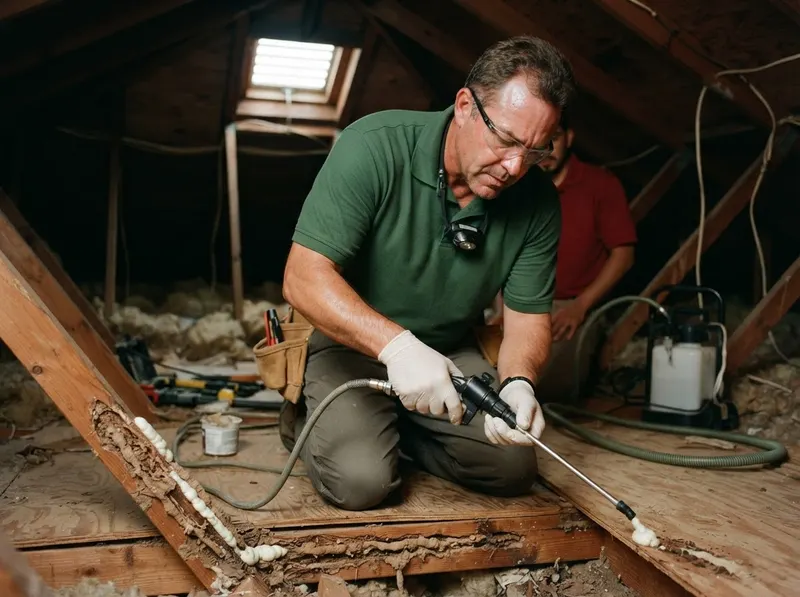
Standard subterranean termites require continuous contact with ground moisture to survive, but Formosan subterranean termites break this rule by constructing aerial carton nests entirely isolated from the soil. In coastal Harris County, high atmospheric humidity exceeding 80% and regular Gulf Coast rain events allow these colonies to thrive above ground wherever a plumbing defect, flashing leak, or condensation pan provides water. An aerial colony bypasses conventional perimeter liquid soil barriers completely. If an infestation maintains ground contact, standard trenching treatments succeed; if workers survive above the treated soil barrier via trapped moisture in a second-story subfloor, specialized aerial remediation becomes necessary to prevent catastrophic wood degradation. The trade-off involves targeted drywall or fascia access holes to inject non-repellent transfer agents directly into the carton material versus facing persistent load-bearing timber loss.
Formosan termite aerial colony remediation relies on accurate structural localization. Moisture meters and thermal imaging cameras trace hidden nest boundaries behind sheetrock, plaster, and commercial siding without exploratory demolition. Technicians inject targeted non-repellent formulations, such as fipronil or specialized insect growth regulators, directly into the carton structure. Workers groom and feed nestmates, spreading the active ingredient through the entire aerial population within 14 to 30 days while leaving non-target areas undisturbed. These low-toxicity, targeted applications remain locked inside wall cavities, protecting household pets and family members from direct surface contact. Over-the-counter surface sprays merely kill visible foraging workers, repelling surviving reproductive pairs deeper into ceiling joists and worsening internal damage.
Building architecture across Houston dictates where aerial colonies nest. In flat-roof mid-century modern properties in Meyerland and older pier-and-beam bungalows in The Heights and Montrose, plumbing runs and flashing junctions often collect persistent dampness. Modern multi-story builds in River Oaks, Memorial, and West University Place frequently conceal aerial nests behind stucco weep screeds, decorative parapet walls, and commercial-grade HVAC chases. Meanwhile, dense tree canopies and elevated moisture off Lake Houston and Clear Lake create sustained microclimates in Kingwood, Oak Forest, and Clear Lake subdivisions that sustain elevated colonies. Remediation requires paired moisture mitigation: roofers or plumbers must resolve underlying water sources, because a dry wall cavity cannot support Formosan re-infestation.
Every job gets a firm, written price after a free on-site visit.
Tell us about your formosan termite aerial colony remediation job in Houston and we'll send a clear, written quote, usually the same day.
 Bayou Hawk Pest Control