Bayou Hawk Pest ControlBayou Hawk Pest Control

Subterranean Termite Soil Treatment Houston

Subterranean termite soil treatment targets subterranean worker castes before structural cellulose timbers are compromised. In Harris County, heavy seasonal rainfall and high water tables push subterranean colonies…
Get My Free Estimate →(346) 776-0842
Subterranean Termite Soil Treatment in Houston, TX
Quick answer
  • What is included: Continuous perimeter soil trenching, foundation rod-injection around piers, expansion joint drilling, and non-repellent liquid termiticide placement.
  • Response timing: On-site property evaluations scheduled within 24 to 48 hours across Harris County, with complete perimeter applications completed in 4 to 8 hours.
  • Estimated pricing: Total project costs range from $850 to $2,500 based on linear footage, with a strict diagnostic minimum charge of $250.
  • Target pests treated: Native subterranean termites (Reticulitermes virginicus and Reticulitermes flavipes) and invasive Formosan subterranean termites (Coptotermes formosanus).
  • Booking protocol: Confirm an inspection by calling (346) 776-0842 to map structural perimeters, verify soil composition, and receive a binding on-site quote.

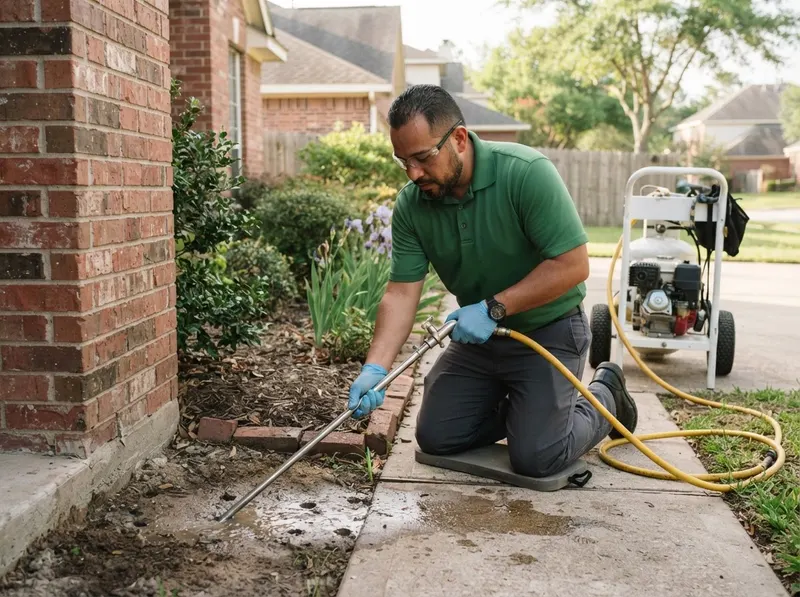
Subterranean termite soil treatment targets subterranean worker castes before structural cellulose timbers are compromised. In Harris County, heavy seasonal rainfall and high water tables push subterranean colonies upward through expansive Beaumont clay. A proper liquid application involves excavating a continuous 6-inch by 6-inch trench immediately adjacent to the exterior foundation walls, applying four gallons of finished liquid dilution per 10 linear feet. Technicians rodding the soil reach down to the top of the footing. Properties constructed on monolithic concrete slabs, common throughout River Oaks, Oak Forest, and The Heights, require precision vertical drilling through attached carports, brick veneer weep holes, and patio slabs every 12 inches to bridge exterior gaps. This creates an unbroken zone that prevents insects from exploiting unseen slab cracks.

Choosing continuous soil treatment over topical wood sprays or localized bait systems resolves termite pressure through total perimeter exclusion rather than passive feeding. Over-the-counter surface sprays merely kill visible foraging workers, which prompts subterranean colonies to seal off treated tunnels and seek alternative structural entry points behind sheetrock. Professional non-repellent termiticides allow workers to pass freely through the treated zone without detection. Workers transfer the active ingredient directly to the queen and nest mates through daily grooming, collapsing colonies nesting 10 to 15 feet underground. For historic pier-and-beam bungalows in Montrose or Meyerland, this method requires trenching and treating the perimeter of every individual foundation pier alongside exterior grade beams, demanding roughly double the linear footage of a standard slab home.

Property construction and soil characteristics determine whether liquid soil treatments or subterranean baiting systems provide the superior defense. If a home sits on permeable sandy loam in Kingwood or features extensive mature root zones against the foundation wall, liquid barriers settle uniformly. If a structure in Clear Lake sits directly adjacent to standing bayou waterways or features an interior cistern, mechanical bait stations are often chosen to prevent termiticide drift into nearby surface water. The practical trade-off centers on application permanence versus long-term inspection schedules: a complete perimeter liquid barrier delivers continuous protection for five to ten years with zero homeowner monitoring, whereas monitoring stations demand quarterly re-inspections and active cartridge replacement. Each application is calibrated around family foot traffic, shielding interior crawl spaces without off-gassing into living quarters.

Subterranean Termite Soil Treatment cost in Houston

Minimum Diagnostic Inspection & Assessment$250
Standard Slab Perimeter Treatment (120, 180 Linear Feet)$850, $1,450
Large Slab or Multi-Level Treatment (180, 250+ Linear Feet)$1,450, $2,200
Pier-and-Beam Pier Trenching & Grade Beam Treatment (Memorial / West University)$1,600, $2,500

Every job gets a firm, written price after a free on-site visit.

Common questions

How does Houston expansive clay affect the longevity of a subterranean termite soil treatment?
Houston clay soils swell during tropical rainfall and shrink during prolonged summer droughts, causing perimeter soil shifting that can physically crack or separate chemical barrier zones. Applying the required volume of four gallons per 10 linear feet directly against the grade beam ensures deep saturation past topsoil movement lines.
Will a soil termiticide application harm household pets or plants in Houston yards?
Non-repellent liquid termiticides bind tightly to soil organic matter once dry, typically within two to four hours of application. Keeping dogs, cats, and family members off the direct trenching zone during active liquid placement prevents accidental exposure while outdoor perimeter work finishes.
Can Houston homeowners treat subterranean termites using store-bought spot foams?
Store-bought foams address only the small percentage of termites currently chewing inside visible studs, leaving the primary colony active beneath the foundation. Professional soil treatment delivers high-volume subterranean liquid barriers that eradicate the subterranean colony at the subterranean nest source.
How long does a complete subterranean termite soil treatment take on a standard Houston residence?
Treating a standard 1,800-square-foot home in West University Place or Memorial generally requires four to six hours of continuous on-site labor. The installation involves trenching dirt zones, drilling concrete patios or garage slabs at 12-inch intervals, injecting termiticide, and sealing core holes with structural mortar.
What happens if a property in Houston has foam board insulation below the grade line?
Exterior insulation finishing systems extending below the soil line allow subterranean termites to tunnel invisibly behind foam without touching treated ground. Technicians must notch or clear back insulation material down to the foundation concrete before trenching to avoid leaving protected transit conduits.

Get started today

Tell us about your subterranean termite soil treatment job in Houston and we'll send a clear, written quote, usually the same day.

Get your free Pest Control Service quote, Houston

We only use your ZIP to check availability, no spam.